
The Direct-to-Film (DTF) printing industry has exploded over the last several years. Today there are dozens—if not hundreds—of companies selling what appear to be unique DTF printer brands. New names enter the market every month, each claiming to offer proprietary technology, exclusive engineering, or revolutionary features.
The reality is much different.
Most commercial DTF printers sold throughout North America and Europe are built using the same manufacturing ecosystem in China. Understanding how these printers are designed, assembled, and branded helps explain why many machines look alike, use the same parts, and often experience the same maintenance issues.
This article takes a closer look inside the Chinese manufacturing process and explains the differences that actually matter when purchasing a DTF production system.
One Industry, Many Factories
Unlike companies such as Epson, Canon, or HP that engineer and manufacture complete printing systems, most DFT printer manufacturers operate as assemblers rather than original equipment manufacturers (OEMs).
Instead of one factory producing an entire printer from start to finish, the production process is divided among dozens of specialized suppliers.
For example:
- Steel frame manufacturers build printer chassis
- Precision machine shops produce aluminum rails and brackets
- Electronics companies manufacture controller boards
- Motion-control suppliers build servo systems
- Cable manufacturers produce wiring harnesses
- Ink circulation companies manufacture pumps and manifolds
- Epson supplies the printheads
- Sensor manufacturers produce optical sensors and encoders
- Dryer manufacturers build powder shaker systems
These components are then shipped to assembly factories where they become complete printers.
Think of it like building a custom PC. Intel doesn't build the motherboard. NVIDIA doesn't build the power supply. Samsung doesn't build the case. Each company specializes in one component before everything is assembled into one finished product.
DTF manufacturing works much the same way.
Assembly Factories Create the "Brand"
One of the biggest misconceptions in the DTF industry is that each brand owns a unique printer design.
In reality, many assembly factories offer what is known as ODM (Original Design Manufacturing).
This means they already have a completed printer platform.
Distributors around the world simply choose:
- their own paint colors
- logo
- decals
- software branding
- chassis design
- optional accessories
The exact same mechanical printer may ultimately be sold under ten or more different brand names around the world. Only the cosmetics - the chaisie has changed.
This is why technicians frequently recognize printers from different brands as being mechanically identical once the covers are removed.
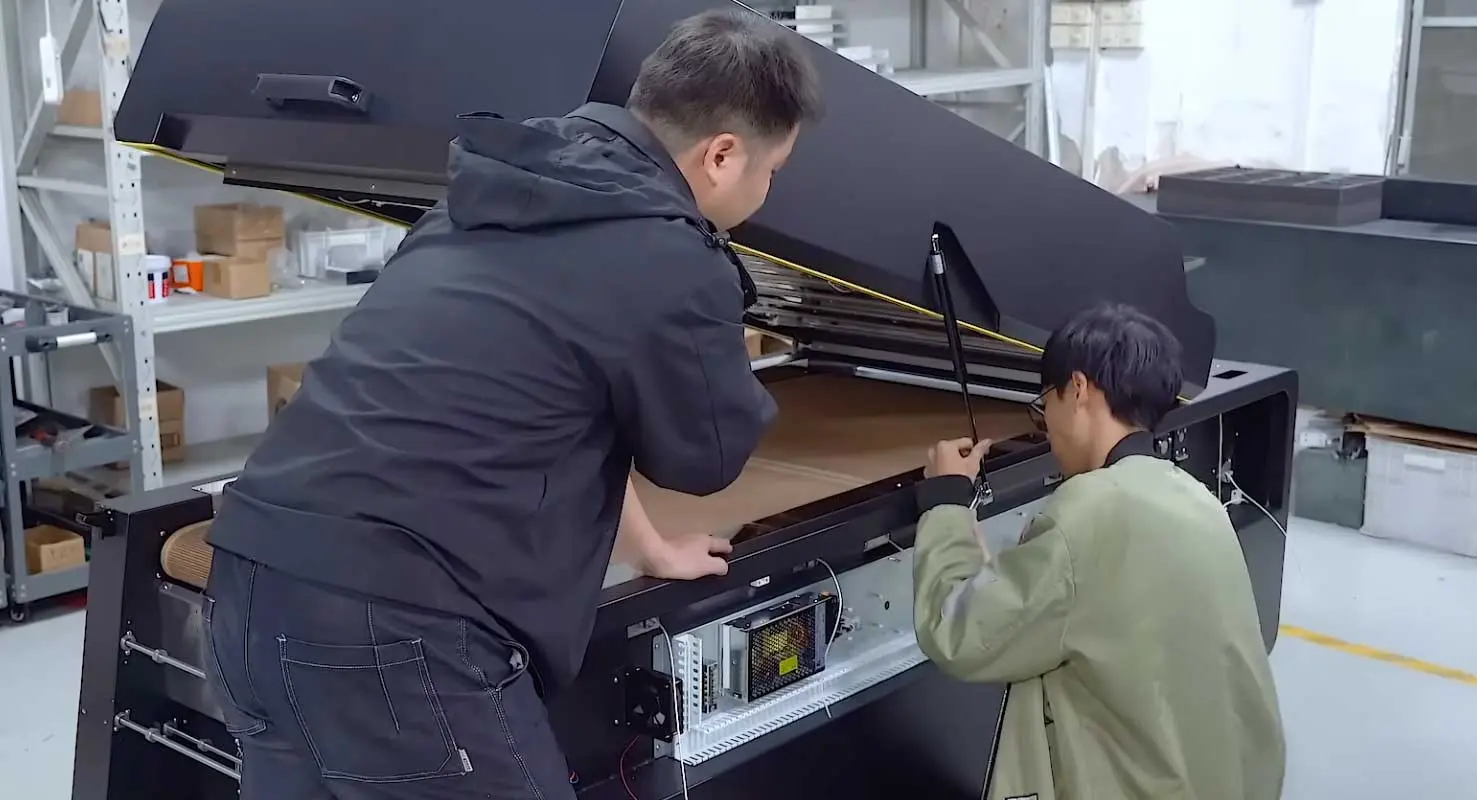
The Chassis May Look Different...
...but the Machine Often Isn't
Manufacturers know customers want something that appears unique.
For that reason they frequently redesign:
- Front covers
- Door panels
- LED lighting
- Touchscreen location
- Side panels
- Powder shaker covers
These cosmetic differences create the appearance of an entirely different printer.
Internally, however, many machines share identical:
- Linear rails
- Motors
- Pumps
- Sensors
- Ink delivery systems
- Electronics
- Firmware architecture
This is why replacement parts from one supplier often fit another manufacturer's machine.
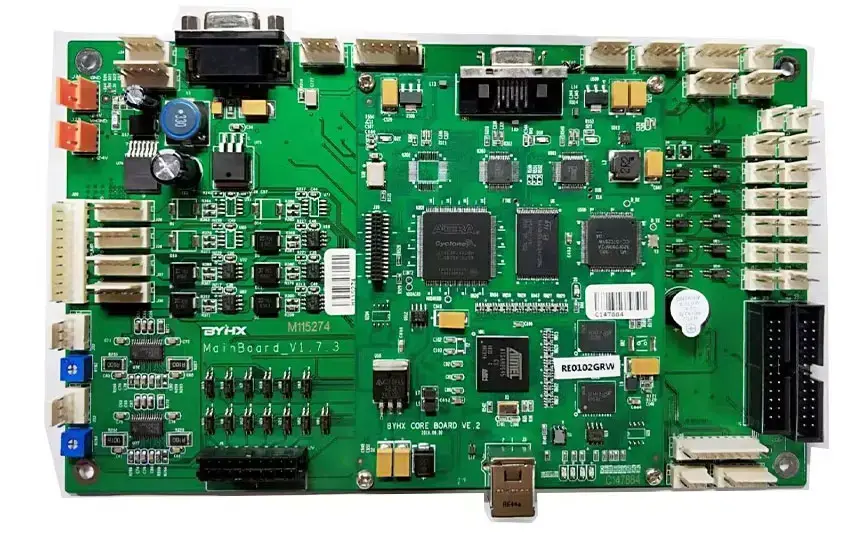 The Two Most Common Controller Platforms
While many components are interchangeable, one area that truly differentiates DFT printers is the controller board.
Today, two manufacturers dominate the market:
BYHX Controllers
BYHX has become one of the largest industrial inkjet controller manufacturers in China.
Their systems are known for:
- Excellent industrial stability
- Strong white ink management
- Advanced waveform control
- Broad compatibility with RIP software
- Extensive diagnostic tools
- Large worldwide installed base
Many higher-production DTF systems utilize BYHX because of their mature software platform and long history in industrial digital printing.
Advantages include:
- Better troubleshooting capability
- More service documentation
- Wide technician familiarity
- Large ecosystem of replacement boards
Hoson Controllers
Hoson is another major controller manufacturer that has gained significant popularity.
Hoson systems generally offer:
- Modern interface
- Fast processing
- Excellent image quality
- Competitive pricing
- Strong integration with newer printer platforms
Many manufacturers prefer Hoson because of its flexibility and lower overall system cost.
Over the last several years Hoson has continued improving firmware and printhead management, making it a serious competitor to BYHX.
Is One Better Than the Other?
This question is similar to asking whether Ford is better than Chevrolet.
The answer depends more on:
- firmware implementation
- machine design
- technical support
- installer experience
DTF Tech Gurus thinks so, but again, we are more familiar with this component and it works well with Wasatch Rip Software. This does not mean that Hoson is inferior, but we will say this - when asking one OEM whether the multi-printhead unit that they were creating was Hoson or BYHX, their response was "Hoson boards can not handle the additional printhead configuration". But keep in mind the controller is only one piece of the overall system. Check out our article on "BYHX vs. Hoson digital components" or even watch Scott Hopper, DTF Tech Gurus discuss this on YouTube.
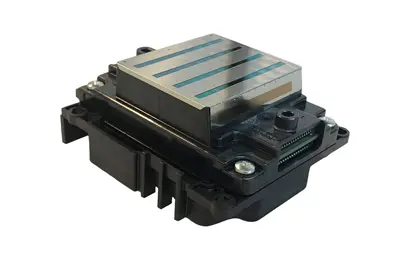
Epson Printheads: The Heart of Every DTF Printer
Perhaps the single biggest misconception in DTF printing concerns printheads.
Many advertisements imply that one manufacturer produces "better Epson printheads" than another.
That simply isn't true.
Nearly every commercial DTF printer uses genuine Epson industrial printheads manufactured by Epson.
The printer manufacturer does not build the printhead.
They simply integrate it into their machine.
Epson i3200 Printheads
The Epson i3200 has become the industry standard for commercial DTF production.
Features include:
- PrecisionCore MEMS technology
- Eight-channel architecture
- High firing frequency
- Excellent drop placement
- Long production life when properly maintained
- Outstanding color consistency
Its balance between speed, quality, and cost has made it one of the most widely used industrial printheads in digital textile printing.
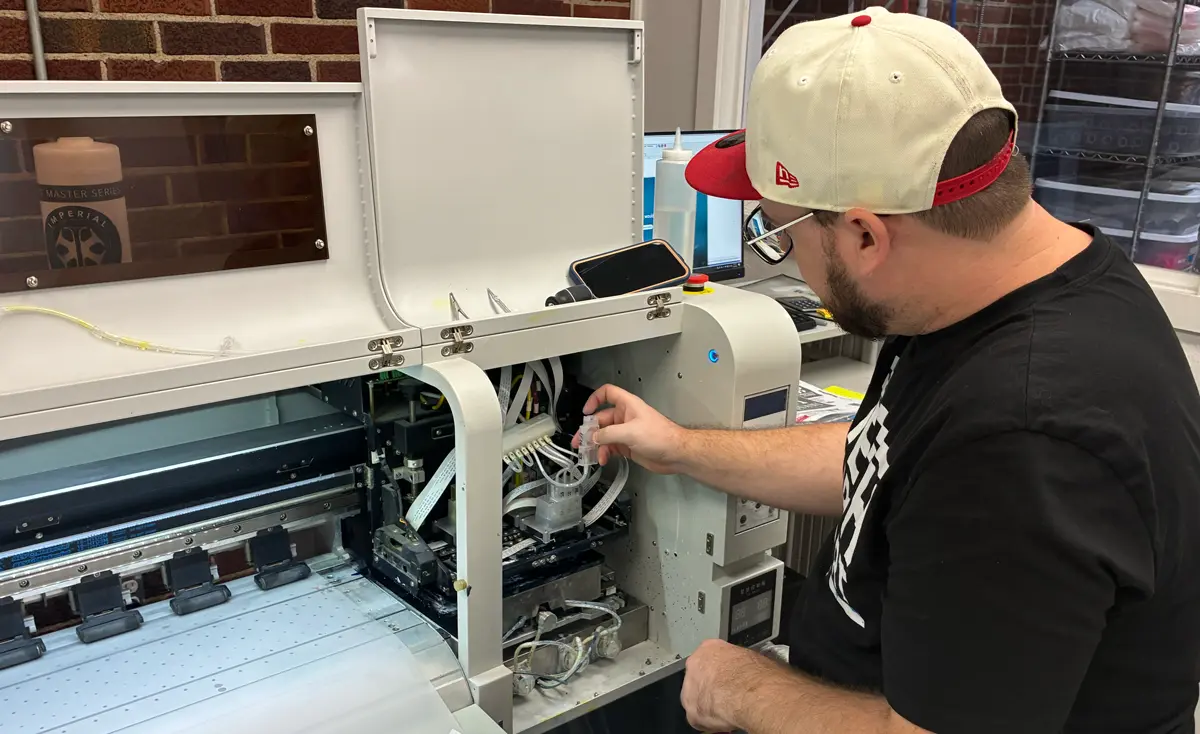
The Biggest Difference Isn't the Hardware
Ironically, the biggest difference between DTF printers often has very little to do with the printer itself.
Instead, it comes down to:
Installation
Proper setup affects:
- printhead height
- carriage alignment
- film tracking
- ink pressures
- white ink circulation
- environmental calibration
Technical Support
A printer is only as good as the people supporting it.
When problems occur, having access to experienced technicians can dramatically reduce downtime. This is where we thrive at DTF Tech Gurus - we know the machines we service inside and out - there isn't one component that we can not diagnosis or fix...we have yet to be stumped! We service X5 DTF Production System, Velox, Velox Plus, Binterjets, Nusign 3060, Spartan and we also can service MImaki TXF150-75.
Training
Even the best machine will struggle if operators do not understand:
- preventive maintenance
- humidity control
- daily cleaning
- ink management
- nozzle recovery
- proper shutdown procedures
At DTF Tech Gurus we just completed a comprehensive User's Guide for the X5 DTF Production System. If you are an OEM or Distributor and you need a User's Guide for your machine, reach out to us, our technicians would love to develop one for your unit.
Consumables
Printer performance depends heavily on:
- ink chemistry
- DTF film quality
- adhesive powder
- cleaning solutions
- filtration systems
Inferior consumables can make an excellent printer perform poorly. We spent a lot of time testing consumables for Imperial DTF and we feel that all the products that they sell are at the top of the market in film, adhesive powder, and DTF ink. There are a lot of great supplies, but you have to find a distributor that isn't going to change or unknowingly change the supplies they are getting from China. Consistency is the name of the game in textile decoration, and your supplies have to perform at a high level consistently as well.
Why Understanding How DTF Printers Are Built Matters
Understanding how DTF printers are manufactured allows buyers to make much more informed purchasing decisions. Once you realize that many machines share common components and are assembled from the same supply chain, it becomes clear that the logo on the side of the printer is only a small part of the equation.
Before purchasing any DTF production system, you should ask questions such as:
- Who provides technical support after the sale?
- Is comprehensive operator training included?
- Are replacement parts stocked domestically?
- How experienced are the technicians supporting the machine?
- Is there a preventative maintenance program?
- Will software and firmware continue to receive updates?
- Are the recommended inks, films, and powders high-quality and thoroughly tested?
These factors will almost always have a greater impact on your long-term success than the brand name printed on the front of the machine.
One reality that every new printer owner needs to understand is this:
Every digital printer will require maintenance and technical support at some point.
Whether it's DTF, UV, eco-solvent, dye sublimation, or direct-to-garment, these are highly sophisticated production machines with thousands of moving parts and precision electronic components. Believing you'll purchase a printer that never needs service is simply unrealistic.
Think of it like owning a vehicle. Even the most reliable truck or car still requires oil changes, filters, tires, brakes, and regular maintenance. No one expects to drive 200,000 miles without servicing it. A DTF printer is no different. Preventative maintenance isn't optional—it's part of owning production equipment.
One story perfectly illustrates this point.
At a trade show, someone approached Scott Hopper of DTF Tech Gurus and asked,
"What's the one thing you don't like about this printer?"
Scott smiled for a moment, pointed at the customer, and replied,
"You—the operator."
At first, that answer may sound harsh, but what he was saying was:
The overwhelming majority of printer problems are not caused by defective machines. More often, they're the result of missed maintenance, incorrect procedures, environmental issues, or small problems that go unnoticed until they become expensive repairs.
That doesn't mean operators are careless or incapable. In many cases, they are simply never taught what to watch for. They don't know how quickly a partially clogged nozzle can become a damaged printhead, how important humidity is to ink performance, or how a neglected ink filter can affect an entire production system.
The problem often isn't the operator—it's the lack of proper training.
Unfortunately, many companies selling DTF equipment focus heavily on making the sale, while training becomes an afterthought. Some provide only a basic startup session, a few PDF documents, or scattered videos covering isolated topics. Once the machine is installed, customers are often left to search YouTube, Facebook groups, or social media creators for answers.
The challenge is that many of those creators are still learning the equipment themselves. Advice shared online is often based on personal experience with one machine rather than a deep understanding of the underlying mechanics, electronics, and chemistry.
Why Don't Most DTF Printers Come with Comprehensive User's Guides?
China has become one of the world's greatest manufacturing centers. Their factories excel at producing high-quality mechanical and electronic components efficiently and at scale. However, manufacturing and education are two very different disciplines.
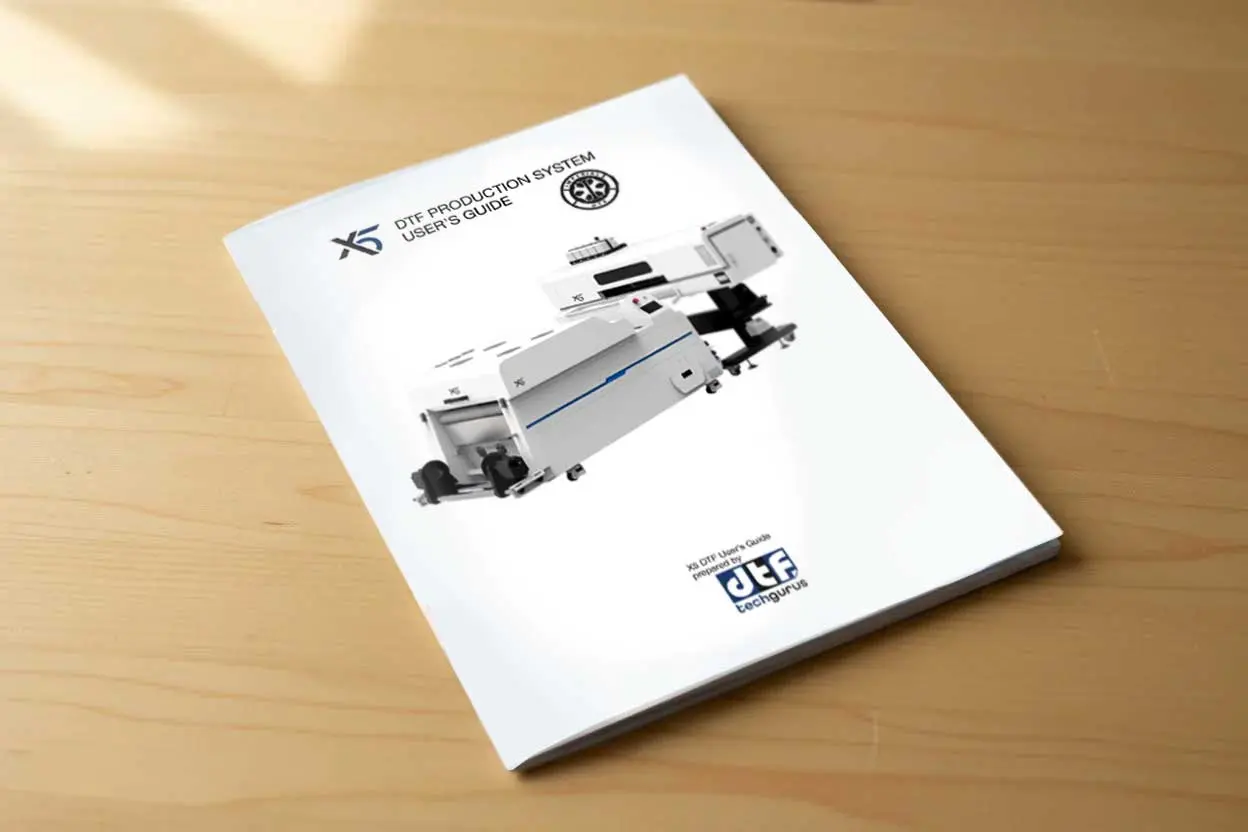 Creating comprehensive documentation takes an enormous investment. Detailed operator manuals, troubleshooting guides, maintenance schedules, and professional training videos require hundreds of hours from experienced technicians, writers, photographers, and video producers. Those resources are rarely prioritized during the manufacturing process because they don't directly contribute to building the printer.
Even after the equipment reaches distributors in North America or Europe, few companies invest heavily in developing complete training programs. The reality is that technical education is expensive to produce, while many customers have come to expect online information to be free. As a result, most distributors concentrate their efforts on sales, installation, and support rather than creating extensive educational resources.
At DTF Tech Gurus, we believe that knowledge is one of the most valuable tools a printer owner can have.
That's why we're taking a different approach.
Rather than relying on marketing slogans, we're building comprehensive user's guides, maintenance videos, troubleshooting resources, and technical training based on decades of real-world digital printing experience. Our goal isn't simply to help you fix problems after they happen—it's to help you understand why they happen and how to prevent them in the first place.
We're technicians first.
That means you'll hear the hard truths about these machines, realistic expectations about maintenance, and practical advice that helps maximize uptime—not just another sales pitch.
Because in the end, the best printer isn't necessarily the one with the newest chassis or the biggest marketing campaign. It's the one backed by knowledgeable people who can help keep it running day after day, year after year.
At DTF Tech Gurus, we believe that educating customers is the most important tool in our "tool box". Sure we can get your printer back up and running, but an informed operator will almost always outperform one who relies solely on brand names or marketing promises. That's why we continue to invest in comprehensive user guides, maintenance resources, and technical training designed to help customers get the maximum performance and longevity from their DTF production systems.